Clear Set Of Processes
Abstract
- Define standardized processes for intake, data access, privacy, stewardship, and governance.
- Use a 3-tier data classification model (L2: default, L1: strategic, L0: PII).
- Form a Steering Committee to review projects, policies, and escalations.
- Enable self-service via data catalogs and automated access workflows.
- Ensure compliance with CCPA/GDPR through structured PII request handling.
- Year 1 cost: $150K–$300K, with scalable, low-friction governance.
Objective
To define a set of standardized, scalable, and secure processes that enable the Data Office to:
- Prioritize the right data initiatives
- Ensure consistent governance and privacy compliance
- Align with executive and business goals
- Enable transparent, secure, and auditable data usage
- Empower self-service analytics while protecting sensitive information
Key Benefits
- Improved alignment between business and data strategy
- Clear decision-making frameworks for project intake and prioritization
- Stronger compliance with CCPA/GDPR and internal policies
- Enhanced trust in data through stewardship, traceability, and classification
- Accelerated time-to-insight while maintaining governance discipline
Proposed Core Data Office Processes
New Data Initiative / Project Intake Process
Purpose: Allow business units to propose new data use cases (e.g., analytics, dashboards, AI models)
Steps:
- Submission via a centralized portal (template includes: business impact, data domains needed, urgency)
- Review by a Data Governance Steering Committee (meets monthly)
- Scoring by criteria (ROI, risk, compliance, technical complexity)
- Prioritization and assignment to Data Office squads
Tools: Notion, Jira, or ServiceNow
Template: Standard intake form with weighted scoring
Frequency: Continuous intake with monthly review
Data Governance Steering Committee Formation
Purpose: Ensure governance policies reflect cross-functional priorities
Structure:
Chair: Chief Data Officer
Voting Members: 1 per business function (Marketing, R&D, Finance, Ops, Legal)
Non-voting Advisors: Data Architects, InfoSec, Legal, Compliance
Elections / Terms:
- Members selected by business unit heads (1-year renewable terms)
- Meets monthly, emergency sessions ad hoc
Responsibilities:
- Policy creation (retention, classification, access)
- Escalation authority for Level 0/1 data access
- Project prioritization and investment alignment
Data Classification & Access Control Process
Purpose: Enforce a tiered access model based on sensitivity and business criticality
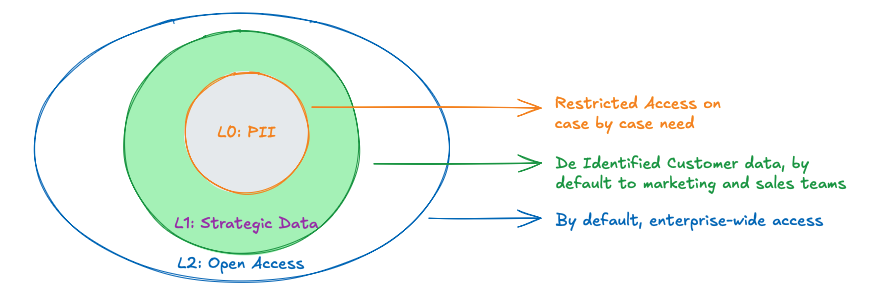
| Level | Description | Access Rules |
|---|---|---|
| Level 2 | Default data (non-sensitive, widely used KPIs) | Free access (open to company employees) |
| Level 1 | Strategic internal data (e.g., pricing, sales forecasts) | Requires BU + CDO approval |
| Level 0 | PII, HR, compliance-bound data | Requires InfoSec + Legal + CDO approval |
Implementation:
- Data tagged with level in catalog (Atlan or Purview)
- Policies enforced via IAM, SSO, data masking tools (e.g., Snowflake, Power BI)
- Quarterly review of access lists
Data Extraction / Right to Erasure (CCPA/GDPR) Process
Purpose: Ensure compliance with privacy regulations for deletion or extraction of personal data
Steps:
- Request intake via privacy portal (authenticated user)
- Lookup across governed datasets (automated via OneTrust + Ataccama / Snowflake tags)
- Approval routing to InfoSec, Legal
- Data redaction or deletion executed via data engineering team
- Audit trail stored in secure repository
Timeline SLA: 30 days (regulatory requirement)
Tools: OneTrust, Ataccama, legal DSR module, Snowflake tagging, Glue job triggers
Self-Service Data Access Workflow
Purpose: Empower analysts and citizen data users with governed access to certified data sets
Steps:
- User browses catalog (Informatica, Collibra, Sales Force, etc...) and requests access to Level 1/2 datasets
- Approvals via automated workflow (manager + CDO delegate for Level 1)
- Access granted via group-based role assignment in Snowflake / Power BI
Features:
- Audit logs of all approvals and access
- Revocation after 90 days unless renewed
Data Stewardship & Quality Reporting
Purpose: Maintain trust and ownership of datasets
Process:
- Every dataset is assigned a data owner + steward
- Data quality metrics (freshness, null %, row counts) monitored via Soda.io or Great Expectations
- Monthly report to Governance Committee
Tools: dbt tests, data quality dashboards, incident workflow via Jira
Execution Plan & Timeline (12 Months)
| Phase | Duration | Key Deliverables |
|---|---|---|
| Phase 1 | 0–2 months | Define data levels, draft policies, form Steering Committee |
| Phase 2 | 2–4 months | Launch project intake workflow, access request templates |
| Phase 3 | 4–6 months | Implement classification in catalog; tag existing datasets |
| Phase 4 | 6–9 months | Pilot privacy/erasure requests; roll out dashboards |
| Phase 5 | 9–12 months | Conduct audits, adjust based on feedback, publish KPIs |
Ideal Templates
- Project Intake Template
- Business impact, data domains needed, urgency, expected ROI, data sensitivity level
- Access Request Form
- Dataset, Level, Justification, Duration, Manager approval
- Stewardship Dashboard
- Data health, ownership, incident log, SLA adherence
- PII Request Tracker
- ID, dataset match, owner notified, actions taken, time to resolution
Estimated Cost of Process Implementation
| Component | Cost |
|---|---|
| Process Design & Consulting | $50K–$100K |
| Workflow Automation Tools (ServiceNow, Notion, custom apps) | $30K–$60K |
| Legal/Compliance Tooling (privacy portal, DSR) | $40K–$80K |
| Staff Time (Training, Workshops, Audits) | $50K–$100K |
| Total | $150K–$300K (Year 1) |
Data Office Core Processes
sequenceDiagram
    autonumber
    participant BU as Business Units
    participant DO as Data Office
    participant GC as Governance Council
    participant IS as InfoSec / Legal

    BU->>DO: Submit new business data request
    DO->>DO: Prioritize request and align with data strategy
    DO->>DO: Allocate resources & assign data stewards

    DO->>DO: Extract and ingest data (from sources)
    DO->>DO: Clean, transform and normalize data
    DO->>DO: Enrich and catalog datasets

    alt Level 2 (Open Data)
        DO->>BU: Publish to company-wide self-service portal
    else Level 1 (Strategic Data)
        DO->>GC: Submit gate review for strategic approval
        GC->>DO: Approve with restrictions
        DO->>BU: Share restricted access dataset
    else Level 0 (Sensitive/PII)
        DO->>IS: Submit request for legal and InfoSec review
        IS->>DO: Validate CCPA/GDPR compliance
        DO->>BU: Release dataset under access controls
    end

    BU->>BU: Consume data in analytics/products
    DO->>GC: Report usage metrics and update data classification
    IS->>DO: Monitor for audit and compliance
Data Office Processes + Tools + Timeline
flowchart TD
    %% Timeline Stages
    subgraph Phase_1["Phase 1: Setup (0–2 months)"]
        P1["Define Data Levels (0/1/2)"]
        P2[Form Governance Committee]
    end

    subgraph Phase_2["Phase 2: Intake & Catalog (2–4 months)"]
        P3[ServiceNow: Project Intake Form]
        P4[Governance Scoring Workflow]
        P5[Assign Steward & Tag Dataset]
        P6[Microsoft Purview: Register Metadata]
    end

    subgraph Phase_3["Phase 3: Access Controls (4–6 months)"]
        P7[Snowflake IAM: Implement Role-Based Access]
        P8[Power BI: Configure Data Sharing Rules]
        P9[Apigee: Secure API Access to Level 2]
    end

    subgraph Phase_4["Phase 4: Privacy & Compliance (6–9 months)"]
        P10[ServiceNow: PII Request Portal]
        P11[Automated Matching via Purview Classifications]
        P12[Glue Jobs: PII Redaction / Deletion]
    end

    subgraph Phase_5["Phase 5: Reporting & Automation (9–12 months)"]
        P13[Soda.io / Dynatrace: Monitor Data Health]
        P14[Jira: DQ Incident Routing to Stewards]
        P15[Monthly Report to Governance Committee]
    end

    %% Dependencies & Flow
    P1 --> P3
    P2 --> P4
    P3 --> P4
    P4 --> P5
    P5 --> P6

    P6 --> P7
    P7 --> P8
    P8 --> P9

    P1 --> P10
    P10 --> P11
    P11 --> P12

    P6 --> P13
    P13 --> P14
    P14 --> P15
Notes
- Each Phase represents a major milestone in the rollout of a mature, tool-integrated Data Office.
- Technologies are integrated as real steps:
- OneTrust for intake and PII workflows
- Informatica, Collibra, SalesForce for metadata, classification, and cataloging
- Snowflake / Tableau / Apigee for access enforcement
- Soda.io / Dynatrace / Jira for monitoring and incident response
Risks & Remedies
Risks: - Overly bureaucratic approval flows (especially for Level 0/1 data) - Fragmented process definitions between teams - Inconsistent audit trails for data usage or compliance
Remedies: - Introduce a tiered, SLA-based data request system (e.g., Level 2 self-service, Level 1 reviewed in <48 hrs) - Document and publish standardized processes in a living handbook - Automate logs, approvals, and exception tracking for governance-sensitive data