A Successfull Organization
Abstract
- The Data Office centralizes governance, quality, architecture, and enablement of enterprise data.
- It should report to the CIO, ensuring alignment with IT systems, compliance, and digital strategy.
- Core team of 10–15 FTEs includes CDO, stewards, governance leads, and engineers.
- Tools like Collibra, Informatica, and Purview support cataloging, quality, and MDM.
- Execution spans 30 months: stand-up, pilot, enterprise rollout, and optimization.
- Estimated cost: $5M–$6M over two years, scalable with business value and maturity.
Objective of the Data Office
To establish a centralized function that defines, governs, and enables enterprise-wide data usage, quality, security, and accessibility, ensuring that data becomes a strategic asset for operations, innovation, and compliance.
Benefits
- Consistent and trustworthy data across systems and departments
- Faster time-to-insight for product, manufacturing, and customer analytics
- Improved compliance (e.g., GDPR, ISO, NHTSA reporting)
- Foundation for AI, predictive maintenance, connected vehicle analytics
- Improved efficiency and reduced data duplication across teams
- Strategic alignment between IT and business functions around data use
Ideal Organization Structure: Data Office (within IT or as a Standalone Function)
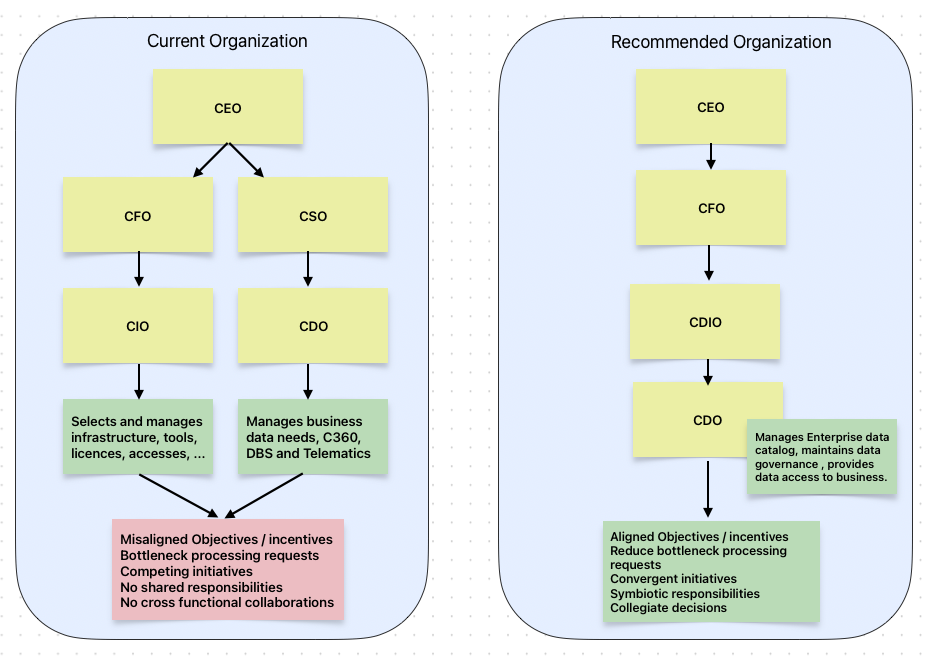
- Recommended Placement: Under the CIO (Chief Information Officer).
- Rationale: Embedding it in IT ensures integration with enterprise architecture, infrastructure, security, and platforms.
- Alternative: - Consider reporting to the Chief Financial Officer (CFO) or CEO, but IT alignment remains critical in automotive.
Ideal Data Office Organization (10–15 FTEs initial core)
| Title | Role & Responsibilities | Scope |
|---|---|---|
| Chief Data Officer (CDO) | Leads strategy, governance, analytics, ensures alignment with business goals | Reports to CFO or CIO |
| Data Governance Lead | Manages policies, stewards, data quality, and regulatory frameworks | Cross-functional governance |
| Data Steward(s) | Maintain data quality, metadata, lineage, and business definitions | Embedded in domains (e.g., Manufacturing, Engineering) |
| Data Architect | Aligns data flows with enterprise architecture and system integration | Partners with IT architecture teams |
| Metadata & Catalog Specialist | Maintains data catalog, glossary, lineage tooling | Tools like Collibra, Atlan, or Purview |
| Data Quality Analyst | Measures and remediates data quality issues | Focused on critical domains (PLM, CRM, etc.) |
| Analytics & BI Lead | Partners with business to surface value from governed data | Interfaces with reporting and data science teams |
| Data Privacy & Compliance Officer | Ensures legal and regulatory compliance across geographies | Coordinates with legal and infosec |
| DataOps/Platform Engineer | Supports technical setup, automation, CI/CD for data pipelines | Works closely with DevOps and cloud teams |
Data Office Organization (under CFO or CIO)
graph TD
    CFO[Chief Information Officer] --> CDO[Chief Data Officer]

    CDO --> DGE[Head of Data Governance & Ethics]
    CDO --> DEP[Head of Data Engineering & Platforms]
    CDO --> DAN[Head of Data Analytics & BI]
    CDO --> DPI[Head of Data Privacy & Compliance]
    CDO --> DSP[Head of Data Strategy & Partnerships]
    CDO --> PMO[Transversal Project Manager]

    DGE --> DG1[Data Governance Manager]
    DGE --> DG2[Metadata & Stewardship Lead]

    DEP --> DE1[Lead Data Engineer]
    DEP --> DE2[Data Platform Architect]
    DEP --> DE3[ETL/Integration Specialist]

    DAN --> DA1[BI Team Lead]
    DAN --> DA2[Data Analyst]
    DAN --> DS1[Data Scientist]

    DPI --> DC1[Privacy Compliance Officer]
    DPI --> DC2[Security & Access Control Analyst]

    DSP --> PM1[Data Product Manager]
    DSP --> UR1[University & Innovation Liaison]
Explanation:
- The Chief Data Officer (CDO) reports directly to the CFO (or CIO depending on what Nissan allows), keeping the function strategically aligned with IT and enterprise goals.
- The CDO oversees 5 core domains, each with their own specialized teams:
- Governance & Ethics: Policy, stewardship, metadata
- Engineering & Platforms: Architecture, pipelines, integration
- Analytics & BI: Dashboards, reports, data science
- Privacy & Compliance: PII handling, regulations, InfoSec controls
- Strategy & Partnerships: Internal roadmaps, vendor relations, university outreach
- A transversal PMO keeps all projects timelines in check
Current Resources:
| Name | Title | Current Scope | Proposed Future Scope |
|---|---|---|---|
| KS | Head of Data Governance & Ethics | ||
| HM | Head of Data Strategy & Partnerships |
Scope of the Data Office
- Enterprise Data Governance
- Data Quality Management
- Master & Reference Data Management
- Metadata Management & Data Cataloging
- Data Architecture Alignment
- Regulatory Compliance (GDPR, NHTSA, ISO)
- Data Literacy & Culture Programs
- Support for AI/ML, BI, and Digital Twins
Execution Plan (12–30 Months)
Phase 1: Standing Up the Office (0–3 months)
- Secure executive support (CFO/CIO/CEO)
- Hire/assign core roles
- Define initial scope and operating model
- Draft charter and KPIs
Phase 2: Design & Pilot (3–9 months)
- Establish governance council and federated model
- Implement data catalog and data quality tool
- Pilot 1-2 business domains (e.g., Vehicle BOM, Warranty Claims)
- Deliver visible business value
Phase 3: Scale & Institutionalize (9–18 months)
- Roll out standards and tools enterprise-wide
- Launch data literacy and training programs
- Embed data stewardship in business units
- Automate compliance and audit reporting
Phase 4: Optimization & AI Enablement (18–30 months)
- Extend platform support for ML/analytics teams
- Expand KPIs to include adoption metrics, quality scores
- Launch data marketplace or access self-service platform
Tools & Environment
- Data Catalog & Lineage: Collibra, Atlan, Alation, or Azure Purview
- Data Quality: Informatica DQ, Talend, Great Expectations
- Master Data Management: Informatica MDM, SAP MDG
- Collaboration & Documentation: Confluence, SharePoint
- Data Platform Support: Snowflake, Databricks, GCP/Azure/AWS (whichever is core)
- Security & Compliance: IAM tools, DLP, data masking, integrated with SOC2 or ISO frameworks
Staffing Plan (Initial Core Team)
| Role | FTE | Avg Salary (USD) |
|---|---|---|
| CDO / Head of Data | 1 | $250K/$350k |
| Governance Lead | 1 | $170K |
| Data Stewards (by domain) | 3 | $150K each |
| Metadata Specialist | 1 | $140K |
| Data Architect | 1 | $160K |
| Quality Analyst | 1 | $130K |
| Platform/Tools Engineer | 1–2 | $150K |
| Privacy Officer | 0.5–1 | $140K |
| Total | 10–11 | ~$1.7M–$1.9M annually |
Estimated Cost (First 2 Years)
| Category | Year 1 | Year 2 |
|---|---|---|
| Staffing (10–11 FTEs) | $1.7M–$1.9M | $1.9M–$2.3M |
| Tool Licenses (Catalog, DQ, MDM) | $400K–$600K | $500K |
| Consulting & Setup (Optional) | $200K–$400K | $100K |
| Training & Change Management | $150K | $100K |
| Total Estimated | $2.5M–$3.2M | $2.6M–$2.9M |
Risks & Remedies
Risks:
- Ambiguous reporting lines or conflicting dual ownership with IT and business units
- Over-centralization creating bottlenecks or resistance in agile business areas
- Lack of alignment with enterprise-wide digital or IT strategy
Remedies:
- Place the Data Office under a hybrid model: operationally within IT, strategically tied to the COO or CDO
- Empower domain-aligned Data Product Owners to bridge business needs with central data functions
- Review org structure annually to realign with evolving priorities and transformation programs