Data Governance
Abstract
- Data Governance ensures trusted, secure, and high-quality data across business units.
- The primary objective is to establish roles, policies, and tools that drive regulatory compliance, operational efficiency, and data-driven innovation.
- Key benefits include improved data quality, reduced silos, regulatory alignment (e.g., GDPR), and readiness for AI/analytics initiatives.
- Execution follows a phased 24-month roadmap: strategy, framework design, pilot, and enterprise rollout.
- A business-led Governance Committee of 3–5 members will drive cross-functional decision-making and ensure alignment with customer, legal, and operational priorities.
- Initial core team of 6–8 FTEs supported by specialized tools for cataloging, quality, and stewardship.
- Estimated 2-year cost: $3M–$4.4M including staffing, software licenses, training, and consulting support.
Objective of the Data Governance Program
To establish clear policies, roles, responsibilities, and processes that ensure high-quality, secure, compliant, and accessible data throughout its lifecycle, supporting strategic, operational, and regulatory needs of the organization.
Benefits
- Improved Data Quality – Accurate, consistent, and reliable data across departments.
- Regulatory Compliance – Align with GDPR, CCPA, ISO 27001, etc.
- Operational Efficiency – Reduce data silos, duplication, and manual reconciliations.
- Trust and Accountability – Clear ownership and stewardship foster a culture of responsible data use.
- Faster Decision-Making – Better data lineage and cataloging improve time-to-insight.
- Enabling AI & Analytics – Trusted data enables scalable use of ML models and business intelligence.
- Business Alignment – Cross-functional governance ensures data policies reflect legal, customer, and operational needs.
Realistic Execution Plan (Phased Approach)
Phase 1: Assessment & Strategy (0–3 months)
- Inventory critical data assets (starting with customer, vehicle, manufacturing data).
- Conduct maturity assessment.
- Identify regulatory gaps and pain points.
- Develop a business-aligned data governance strategy and roadmap.
- Define success KPIs.
- Identify candidates and confirm charter for Governance Committee.
Phase 2: Framework Design (3–6 months)
- Define policies: data quality, classification, retention, privacy, access control.
- Create governance operating model (e.g., Data Owners, Stewards, Council).
- Formally launch Governance Committee and begin regular cadence of decision-making.
- Establish metadata management and data lineage practices.
- Choose pilot domain (e.g., Product Lifecycle Data or After-Sales).
Phase 3: Pilot Implementation (6–12 months)
- Implement governance policies in selected domains.
- Use tools (see below) for cataloging, quality checks, and lineage.
- Train data owners/stewards and hold governance councils.
- Collect feedback, refine policies.
- Governance Committee to review pilot results and refine standards.
Phase 4: Enterprise Rollout (12–24 months)
- Extend policies, roles, and tooling to other data domains.
- Embed governance into workflows (e.g., PLM, ERP, IoT platforms).
- Automate monitoring, audit logging, and remediation processes.
- Continuous communication and change management.
- Governance Committee to oversee enterprise-wide adoption and policy enforcement.
Governance Committee: Structure and Role
Purpose:
To ensure the Data Governance program is business-led, decision-capable, and aligned with enterprise-wide priorities, the organization will establish a Data Governance Committee empowered to approve policies, enforce standards, and prioritize governance activities.
Composition:
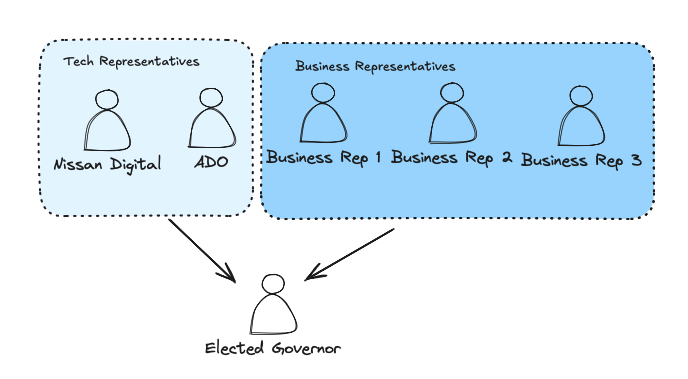
- 3–5 business representatives from key functions (e.g., legal, operations, customer, compliance)
- 2 technical representatives (e.g., Data Architect, Metadata/Lineage Specialist)
- Chaired by a business representative to reinforce operational alignment
- Odd-member structure to enable tie-breaking and decisive action
Responsibilities:
- Approve and publish enterprise-wide governance policies
- Maintain visibility of data policies across the organization
- Oversee mandatory documentation of datasets, schemas, and transformations
- Ensure standardized testing for:
- Column integrity
- Null enforcement
- Business/domain rules
- Champion data quality as a shared responsibility between business and IT
- Align governance activities with corporate initiatives (e.g., digital transformation, regulatory audits)
Operating Model:
- Meets monthly, with ad hoc reviews for major policy changes
- Reports quarterly to CDO and CIO/CFO steering group
- Coordinates with Data Stewards, Council, and technical working groups
Ideal Resources
1. Staffing (Core Data Governance Team - Initial 6–8 FTEs)
| Role | Count | Description |
|---|---|---|
| Chief Data Officer / Head of Data Governance | 1 | Leadership, strategy, executive alignment |
| Data Governance Manager | 1 | Program execution, stakeholder coordination |
| Data Stewards | 2–3 | Domain-specific data management, quality control |
| Metadata/Lineage Specialist | 1 | Tool config, metadata & cataloging |
| Data Architect | 1 | Integration with enterprise architecture |
| Compliance & Privacy Officer | 1 (fractional) | Align with legal and data privacy frameworks |
Expand with federated Data Stewards embedded in business functions.
2. Tools/Environment
- Data Catalog & Lineage: Collibra, Alation, Atlan, Informatica
- Data Quality: Talend, Informatica Data Quality, Great Expectations
- Master Data Management: Informatica MDM, Reltio, SAP MDG
- Collaboration/Documentation: Confluence, Microsoft Teams
- Cloud Integration: AWS Glue Data Catalog, Azure Purview, GCP Data Catalog
- Security & Access Control: Integration with IAM tools (Okta, Azure AD)
3. Environment
- Executive support from CFO/CIO (depending on what organization structure is choosen)
- Federated governance model supported by business units
- Agile or SAFe-aligned delivery process
Realistic Timeline Overview (24-Month Plan)
| Timeframe | Milestones |
|---|---|
| 0–3 mo. | Assessment, strategy, roadmap |
| 3–6 mo. | Operating model, policies, governance body |
| 6–12 mo. | Pilot domain live, feedback loop |
| 12–18 mo. | Expand to additional domains, tool scaling |
| 18–24 mo. | Embed across enterprise, automate reporting, continuous improvement |
Estimated Cost (Year 1–2)
| Category | Year 1 | Year 2 |
|---|---|---|
| Staffing (6–8 FTEs) | $900K–$1.2M | $1M–$1.5M |
| Tools & Licenses | $300K–$500K | $400K–$600K |
| Training & Change Mgmt | $100K | $150K |
| Professional Services (Consulting, Tool Setup) | $250K | $100K |
| Total Estimate | $1.55M–$2.05M | $1.65M–$2.35M |
Optional cost savings: Use open-source (OpenMetadata, Amundsen, DataHub) or native cloud tools if applicable.
Risks & Remedies
Risks:
- Lack of executive sponsorship or prioritization
- Fragmented ownership or passive governance councils
- Misalignment between governance policies and real-world business use cases
Remedies:
- Regular steering committee reviews with executive attendance
- Assign clear data stewardship roles at both strategic and operational levels
- Ensure governance policies are business-informed and reviewed biannually