Recommendations
To unlock the full potential of Nissan North America's (NNA) data assets and transform into a truly data-driven organization, a decisive, top-down strategic realignment is required. The following prioritized recommendations are designed to remove organizational friction, establish clear roles and responsibilities, and ensure long-term operational scalability across all data-related initiatives.
Strategic Data Execution Framework
To guide execution across all phases of NNA's data transformation, I recommend structuring the overall data portfolio around two complementary program pillars:
1. Nissan Data Repository (NDR)
Establish a unified foundation by focusing on:
- Enterprise-wide data discovery, ingestion, and consolidation
- Cleansing, validation, and harmonization of source systems
- Creation of governed, certified datasets ready for downstream use
- Enabling scalable access across curated bronze/silver/gold zones
NDR serves as the “data plumbing” backbone—ensuring accuracy, quality, and accessibility of core datasets.
2. Nissan Data Services (NDS)
Build domain-specific value on top of the cleaned and certified data by focusing on:
- Cross-functional analytics and KPI development
- Customer 360, Parts Inventory, DBS, and Financial analytics
- Data product design, delivery, and embedded reporting
- Collaboration between ADO and business units for insight generation
NDS is the “value engine”—turning raw data into decisions and measurable impact through use-case-driven projects.
3. Nissan Data Lab (NDL)
Build a small, agile team (max 5 people) to serve as a rapid experimentation unit—bridging business needs and technical innovation in a focused, low-risk environment.
- Cross-functional by design: Blend of technical experts and business-savvy profiles
- Timeboxed execution: Deliver 2–3 week proof-of-concepts with clear go/no-go criteria
- Upstream innovation, downstream scaling: Validated PoCs are transitioned to NDS for industrialization and enterprise deployment
NDL is the spearhead of innovation—bringing new technologies and bold ideas into a safe, fast-paced sandbox for real-world testing.
P0. Redefine Vision, Roles, and Objectives: Clarify ADO vs. RDO
Executive Mandate: Clearly articulate and reassert the organization's data vision. Without this, the strategic investments in data infrastructure, personnel, and tooling risk fragmentation.
Action Items:
- Define a 6/12/24-month data vision aligned with business goals.
- Specify ADO’s purpose: data governance body, data product enabler, analytics provider, or all of the above.
- Clarify RDO vs. ADO responsibilities across tool ownership, environment management, governance authority, and delivery accountability.
🔍 Recommendation: A single slide should be created and communicated enterprise-wide delineating the responsibilities and strategic objectives of ADO and RDO.
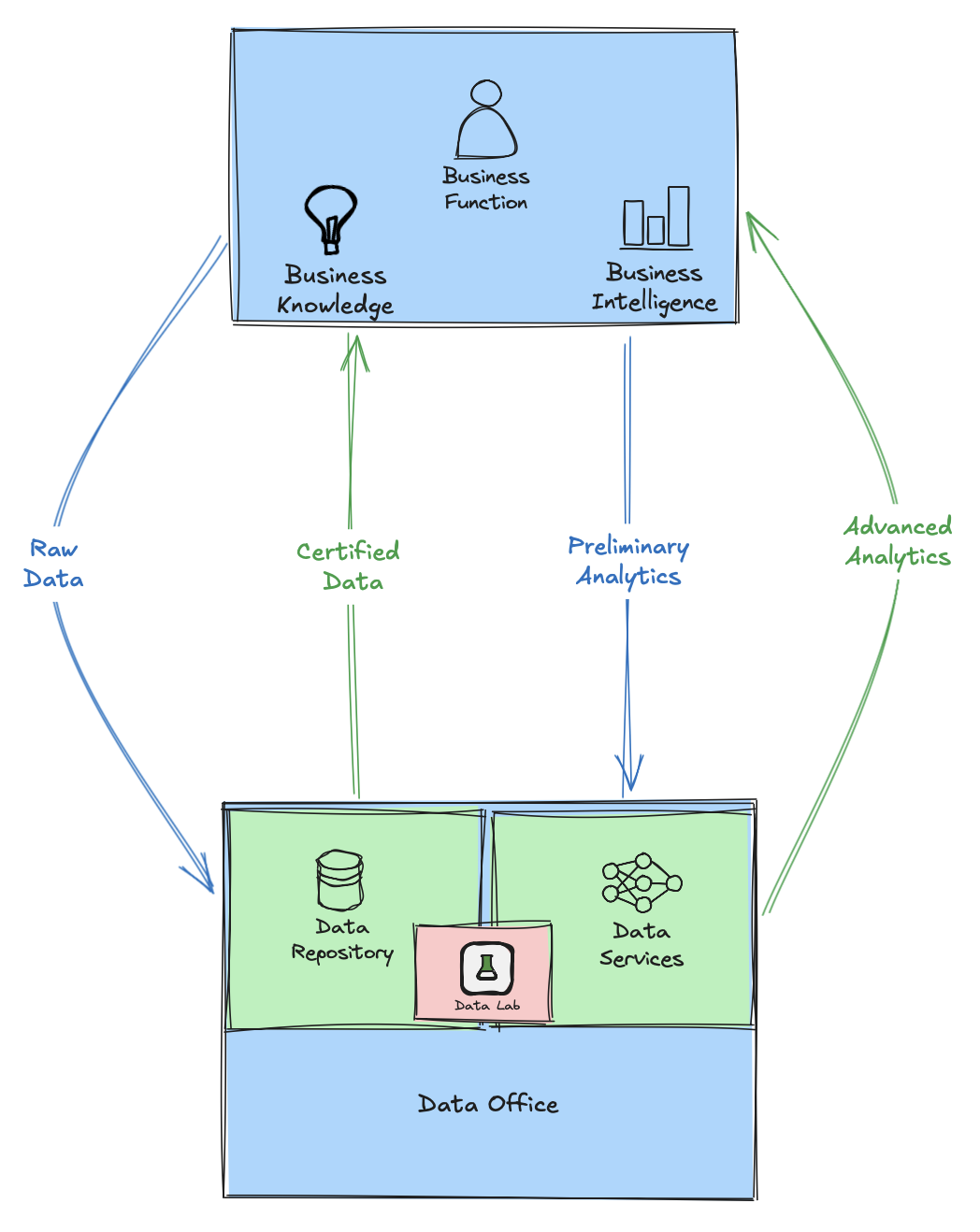
A streamlined, effective symbiotic model: the Business owns the data; the Data Office certifies it.
The Business leads the initial layer of analytics, leveraging its domain expertise, while the Data Office supports by refining, enhancing, and scaling those insights.
Ownership of both the data and the final product stays with the Business; the Data Office acts as an enabler, accelerator, and steward of data quality.
P1. Align Incentives and/or Consolidate Tech Organizations
Executive Mandate: Eliminate internal competition between data and technology teams by unifying leadership under a single SVP or COO with decision-making authority across CIO, CTO, and CDO functions.
Ideal Model:
- CIO – Operational IT (infrastructure, licenses, vendor relationships)
- CTO – Engineering & Software Development (projects, platforms)
- CDO – Data Management & Governance (data pipelines, quality, ownership)
- iLab – Cross-functional PoC engine for 90-day MVPs, co-led by tech and business
This model, widely adopted in the tech industry, can be simplified and rendered compatible to match both cultural organization at NNA and it's current need to improve organization without increasing the number of VP / Directors.
Nissan-Compatible Model:
- CFO - Senior leadership
- CDIO - Reports to CFO, Oversees Digital Assests (Operational IT, Data and Development)
- CDO – Reports to CIO, Data Management & Governance (data pipelines, quality, ownership)
Alternative Nissan-Compatible Model:
- CFO - Senior leadership
- CIO - Operational IT (infrastructure, licenses, vendor relationships)
- CDO – Data Management & Governance (data pipelines, quality, ownership)

Benefits:
- Reduces redundancy and improves accountability
- Establishes shared KPIs around data utilization and product delivery
- Encourages business-first innovation while preserving technical integrity
P2. Implement Enterprise-Wide Data Governance, Quality, and Management
Executive Mandate: Establish a data governance committee with real decision-making power and cross-functional representation. Governance must be business-led to ensure alignment with customer, legal, and operational priorities.
Structure & Best Practices:
- Committee chaired by business (odd-member count, 3–5 members ideal)
- Governance policies published and made visible to the organization
- Mandatory documentation for datasets, schemas, transformations
- Standardize testing for column integrity, null enforcement, and domain rules
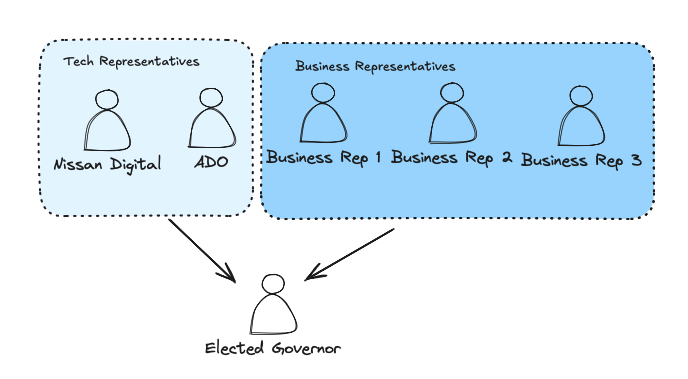
3 Simple rules:
- Governor is always from the business side
- Keep an odd number of participants. I would discourage going over 7 members in total as decision is hard to be made in this case.
- All Data governance decisions and meeting minutes need to be publicly made available for the whole enterprise.
Tooling Recommendation: Adopt scalable data quality platforms (e.g., Ataccama, Informatica, or OpenMetadata) and move away from ad hoc, one-off tools.
P3. Rationalize Project Portfolio
Executive Mandate: Reduce noise and maximize impact by halting or sunsetting underperforming or non-strategic data initiatives. Apply a portfolio management lens to every active project.
Action Items:
- Trim project count by 30–50% within the next quarter
- Focus on 2–3 key data assets: C360, DBS, AfterSales
- Use ROI, adoption metrics, and business dependency as the gating criteria
- Move long-horizon R&D-style projects to the iLab where they can be rapidly tested and either killed or scaled
P4. Reallocate Resources to Critical Path Initiatives
Executive Mandate: Reprioritize existing talent and budget toward near-term data remediation and platform refactoring. Set bold yet achievable milestones for the next 3–6 months.
Short-Term Focus Areas:
- Next 2 Months: Close all outstanding import, access, and duplication issues
- Next 3–4 Months: Refactor ingestion layer into modular, maintainable pipelines
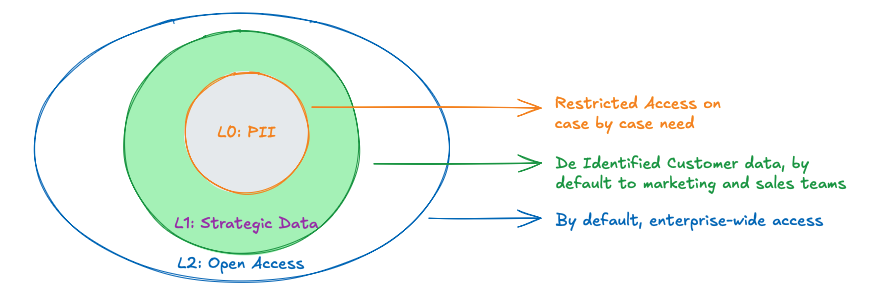
- Within 6 Months: Deploy a standardized PUBLISHED zone (with L0/L1/L2 access tiers) to democratize insights while maintaining data privacy
Additional Strategic Recommendations
Create a Unified, Layered Data Access Model
Why: NNA’s current access model hinders innovation and overwhelms support functions.
Solution: Implement a three-tiered access structure (PII, De-identified, Open) to enable safe, scalable access to 80% of analytics use cases.
Establish Clear Data Ownership
Why: Without explicit ownership, accountability for quality, privacy, and usage will erode.
Solution: Define data ownership rules within governance (e.g., system-of-record owns source data; ADO owns transformed datasets; consumers responsible for derived models).
Industrialize the Data Development Lifecycle
Why: ADO lacks sandbox environments and full tool autonomy, slowing delivery.
Solution: Set up DEV, PRE-PROD, and PROD environments with role-based access controls. Allow ADO to manage its stack and deploy PoCs freely.
Automate and Streamline Data Access
Why: Access delays cripple productivity and morale.
Solution: Introduce default access templates based on roles and project scopes. Fast-track non-PII requests. Remove ERB overhead for exploratory analysis.
Modernize and Simplify Data Architecture
Why: Current architecture (esp. ingestion & MDM stages) is brittle and monolithic.
Solution:
- Break large Lambdas into smaller, testable modules
- Standardize ingestion steps across all pipelines
- Apply zone-based modeling (Bronze/Silver/Gold) with lineage transparency
Launch a One-Stop Data Catalog & Brokering Portal
Why: Employees waste time hunting for data and understanding eligibility.
Solution:
- Implement a self-service data portal for metadata search, access requests, and glossary definitions
- Integrate with governance tooling and approval workflows
Create a iLab: Nissan Data Lab
Why: Innovation is currently hindered by slow processes, rigid governance, and unclear success paths. NNA needs a fast, low-risk way to explore ideas, test prototypes, and validate business impact before scaling.
Solution:
- Establish a dedicated iLab focused on 3-week proof-of-concept (PoC) cycles.
- Co-lead with both business and technical stakeholders to ensure alignment.
- Use small, agile teams (5 members max) with autonomy and sandboxed environments.
- Define clear entry/exit criteria, with PoCs either scaled (via NDS) or sunset based on impact.
- Track outcomes and lessons learned to inform enterprise-wide data strategy.
Conclusion
Data is no longer a back-office function; it is a strategic asset that powers marketing optimization, customer retention, product innovation, and financial rigor. These recommendations are designed to help NNA eliminate current inefficiencies and misalignments and lay the foundation for sustainable, value-driven data maturity.
With a bold executive mandate, aligned incentives, and empowered cross-functional teams, NNA can unlock the full potential of its data ecosystem.